
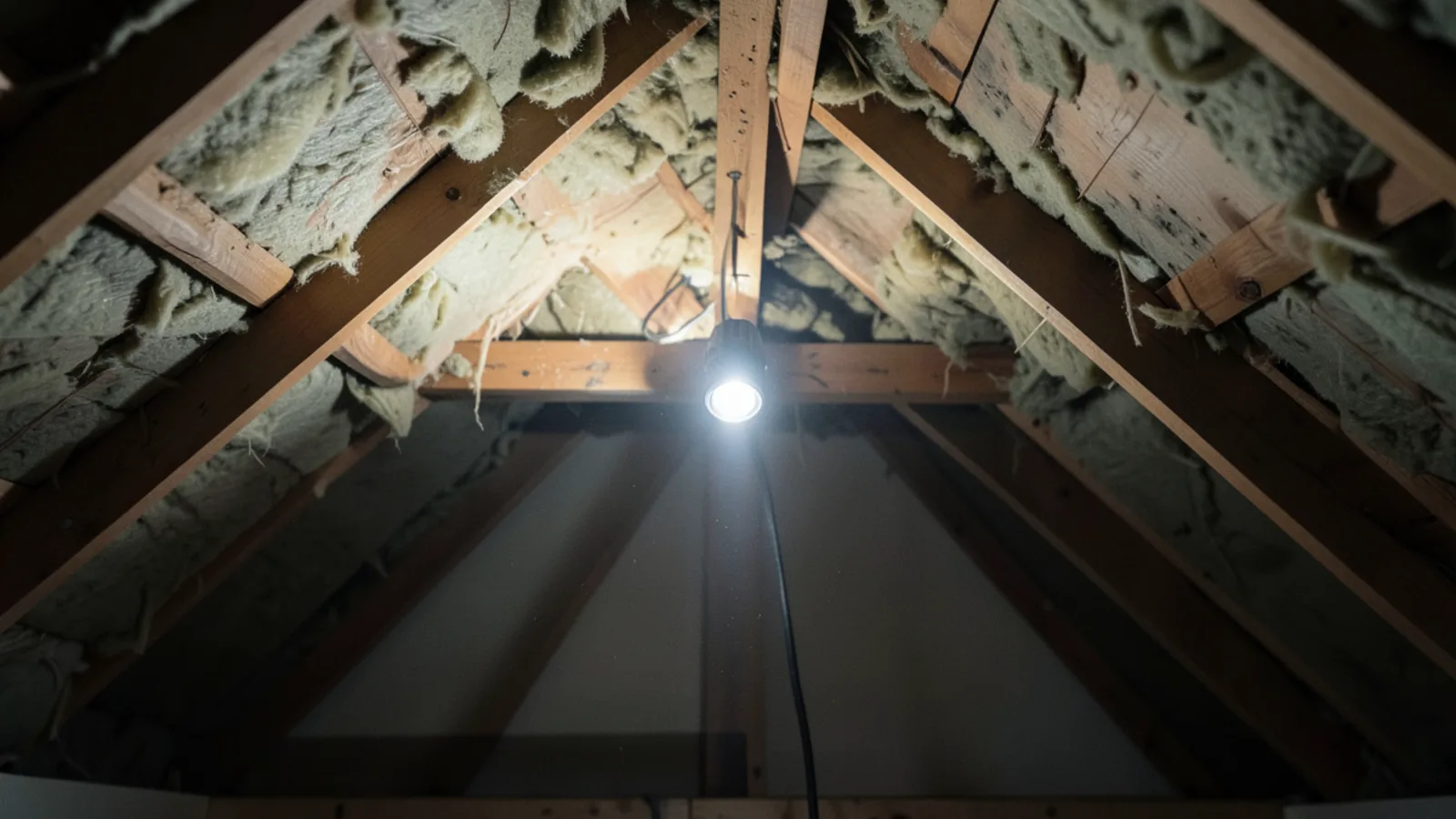
Roof rats in South Hillsborough homes enter through roofline gaps, AC chase openings, and unsealed soffit vents. Permanent removal requires physical structural exclusion (sealing all openings larger than 1/4 inch with galvanized steel mesh), attic snap trapping, and removing exterior tree limbs touching gutters. Chemical baits inside attics must be avoided to prevent foul odors from dead rodents in wall voids. Call (321) 496-4080 for professional exclusion.
- 01.Signs You Have Roof Rats in Your Florida Attic (Acoustics and Physical Evidence)
- 02.Why Tampa Bay Roof Rats Prefer Attics and Palm Canopies
- 03.Florida Contractor Insight: The Serious Danger of Using Poison Baits in Attics
- 04.The 5-Step Trapping and Exclusion Protocol
- 05.Structural Exclusion Materials: Hardware Cloth vs Retail Foam
- 06.Health Risks, Pathogens, and Electrical Hazards in South Hillsborough
Signs You Have Roof Rats in Your Florida Attic (Acoustics and Physical Evidence)
Roof rats (*Rattus rattus*), also known as black rats or citrus rats, are the primary rodent pest infesting residential structures throughout South Hillsborough County. Because they are strictly nocturnal, homeowners rarely see live animals during the day. Recognizing early auditory and physical evidence is critical before a small family group expands into an established colony.
The earliest indicator is distinctive nighttime acoustic activity above ceilings. Roof rats leave their attic nests around 10:00 PM to forage outdoors, returning in the pre-dawn hours between 3:00 AM and 5:00 AM. Homeowners report scratching, scurrying, light thumping, or gnawing sounds directly overhead. In contrast, gray squirrels are diurnal, making noise primarily at sunrise and mid-afternoon.
An attic inspection reveals unmistakable physical signs. Roof rat droppings are dark brown to black, spindle-shaped, and measure 1/4 to 1/2 inch in length with distinctly pointed ends (unlike Norway rat droppings, which are larger with blunt ends). Droppings accumulate along joist runways, near roofline soffits, and around HVAC air handling units.
Because rats have poor eyesight, they navigate along identical pathways every night, leaving greasy, dark "rub marks" (sebum and body oils mixed with dirt) along wooden truss chords, PVC plumbing stacks, and electrical conduits. Homeowners also notice compressed, flattened trails through blown-in fiberglass or cellulose attic insulation.
Crucially, roof rats possess continuously growing incisor teeth that must be kept worn down through constant gnawing. In attics, they chew through plastic PEX plumbing lines (causing mysterious ceiling leaks) and strip the thermoplastic insulation from 120-volt Romex electrical wiring, exposing bare copper conductors and creating severe electrical fire hazards.
Suspecting Rodents in Your Attic or Crawlspace?
Speak with an independent wildlife and rodent exclusion contractor serving South Hillsborough County today.
Why Tampa Bay Roof Rats Prefer Attics and Palm Canopies
Roof rats are arboreal creatures whose evolutionary biology is adapted for life in tree canopies, vines, and elevated structures. In coastal Florida communities like Ruskin, Gibsonton, Riverview, and Apollo Beach, the subtropical landscape provides an ideal outdoor habitat.
Dense stands of native sabal palms, live oaks, queen palms, and overgrown bougainvillea provide natural nesting platforms and travel highways. Palm crowns retain moisture, dead frond boots provide shelter, and backyard fruit trees (such as citrus, mango, avocado, and loquat) supply abundant food sources year-round.
Residential attics offer roof rats an elevated environment that mimics a hollow tree canopy, completely protected from terrestrial predators like coyotes, foxes, and neighborhood dogs. During scorching summer afternoons, attic temperatures can exceed 130°F, prompting rats to retreat into insulated exterior wall voids or beneath AC ductwork where air conditioning leakage creates cooler microclimates.
Following tropical storms, hurricanes, or heavy seasonal river flooding along the Little Manatee and Alafia rivers, ground-level burrows become saturated, triggering mass upward migrations of rodents into residential rooflines.
Florida Contractor Insight: The Serious Danger of Using Poison Baits in Attics
When homeowners first hear scurrying in their attic, their immediate reaction is often to purchase retail rodenticide bait blocks from a home improvement store and toss them across the insulation. In Florida subtropical climate, this is the single worst mistake a property owner can make.
Anticoagulant rodenticides do not kill rodents immediately. They require three to seven days to induce fatal internal hemorrhaging. During this time, the poisoned animal experiences severe thirst and disorientation, instinctively seeking out the deepest, coolest, most inaccessible voids in the building—such as hollow spaces behind acrylic shower inserts, narrow gaps inside drywall stud cavities, or beneath subflooring.
When the rat dies inside an inaccessible wall void in 90-degree Florida heat, the carcass decomposes rapidly. Within 48 hours, it produces a suffocating, putrid odor of decomposition that permeates living spaces, bedrooms, and HVAC returns for three to four weeks. Standard deodorizers cannot mask the smell, and removing the carcass frequently requires cutting into finished drywall.
Furthermore, decomposing rodent carcasses attract secondary pest infestations, including blow flies, flesh flies, skin beetles, and rat mites that subsequently migrate into living quarters to bite human occupants. Poisoned rodents that stumble outdoors also cause secondary poisoning deaths in local non-target wildlife, including owls, hawks, eagles, and domestic pets.
For these reasons, reputable independent pest contractors enforce a strict policy: mechanical snap traps only inside residential attics, reserving secured, tamper-resistant bait stations exclusively for exterior perimeter defense.
The 5-Step Trapping and Exclusion Protocol
Permanent rodent eradication requires a methodical, two-phase approach: sealing the building envelope to prevent new entries, followed by rapid mechanical trapping to remove animals stranded inside.
Structural Exclusion Materials: Hardware Cloth vs Retail Foam
The durability of a rodent exclusion project depends entirely on the physical materials used to seal structural entry points. Many homeowners attempt DIY repairs using standard expanding foam sealant, only to find that rats gnaw through the cured foam within hours.
Roof rats have enamel on their incisors that rates 5.5 on the Mohs hardness scale—harder than copper and iron. They can easily chew through soft wood, plastic, vinyl soffits, and retail spray foam.
| Exclusion Material | Durability Against Roof Rats | Recommended Application Location |
|---|---|---|
| 1/4-Inch Galvanized Hardware Cloth | Permanent barrier; cannot be chewed | Soffit returns, gable vents, and foundation weep holes |
| Heavy Gauge Metal Flashing | Permanent barrier; chew-proof | Roofline drip edges, fascia transitions, and valley junctions |
| Stainless Steel / Copper Stuf-fit Mesh | Chew-proof; will not rust or stain | Packed into pipe penetrations, AC chases, and barrel tile voids |
| Expanding Polyurethane Foam Alone | Fails rapidly; rodents easily chew through | Never use alone; only as a secondary weather seal over steel mesh |
| Standard Window Screening | Fails within days; claws and teeth shred mesh | Inadequate for rodent defense; replace with heavy wire cloth |
Health Risks, Pathogens, and Electrical Hazards in South Hillsborough
A roof rat infestation represents more than an annoyance; it is a serious environmental health and property hazard. In Florida, rodents carry various pathogenic organisms that can be transmitted through direct contact, inhalation of dried fecal dust, or ectoparasite vectors.
Roof rats are documented vectors of murine typhus (*Rickettsia typhi*), transmitted through rodent fleas. Inhaling dust contaminated with rodent urine or feces can cause lymphocytic choriomeningitis (LCMV) and salmonellosis. Additionally, rat urine contains leptospires that cause leptospirosis, a bacterial disease that attacks kidney and liver function in humans and dogs.
The structural threat is equally urgent. The National Fire Protection Association (NFPA) estimates that an unknown percentage of unexplained residential structural fires originate from rodent-damaged wiring. When rats chew through insulation in dark attic corners, exposed hot and neutral wires spark against dry wooden trusses or blown-in insulation, igniting attic fires.
South Hillsborough Roof Rat Control Questions & Answers
An adult roof rat can compress its skeleton to squeeze through any opening larger than a half-inch (roughly the size of a nickel). Young juvenile rats and mice can enter gaps as small as a quarter-inch (the size of a dime).
- The Roof Rat in Florida — University of Florida IFAS Extension
- Rodent Prevention and Control Guidelines — Florida Department of Health